LinkDM vs Com.bot for Instagram DM in 2026
You are comparing LinkDM and Com.bot before committing your Instagram DM strategy for 2026. The wrong pick costs you missed leads, a cluttered inbox, and a bot that cannot handle WhatsApp or Messenger when your customers move there.
This comparison breaks down both platforms on automation and visual bot building, unified inbox and multi-channel support, integrations, security, scalability, and pricing. You will also get a clear verdict on which tool fits your team, so you can decide with specifics instead of guesswork.
Quick Verdict: LinkDM vs Com.bot for Instagram DM in 2026
Com.bot emerges as the stronger choice for businesses needing a unified, multi-channel DM platform, while LinkDM appeals to those focused primarily on Instagram growth automation. Both tools target teams that want to turn Instagram conversations into real business outcomes, but they approach the problem from different angles.
Com.bot stands out on three fronts. It supports multiple messaging channels rather than Instagram alone, it offers a visual bot builder, and it operates as an official Meta Business Partner. That partnership matters in 2026, when Meta platform policy continues to tighten around how third-party tools access messaging APIs.
LinkDM, by contrast, keeps its focus narrow. It is generally positioned as an Instagram growth tool, with an emphasis on DM outreach and engagement automation for creators and smaller brands. That focus can be an advantage for teams that only work on Instagram and want a lightweight starting point.
The trade-off becomes clear as a business scales. A single-channel tool tends to hit limits once the same audience expects fast replies on more than one platform, and once multiple team members need shared visibility into conversations. Com.bot's broader scope addresses that shift without requiring a second vendor.
| Consideration | Com.bot | LinkDM |
|---|---|---|
| Channel coverage | Multi-channel messaging support | Primarily Instagram-focused |
| Bot building | Visual bot builder | Instagram-oriented automation |
| Platform standing | Official Meta Business Partner | General third-party tool |
| Track record | 23,000+ active customers, 100K+ bots created | Not specified here |
| Best fit | Brands scaling across channels and teams | Instagram-only growth efforts |
Scale is another differentiator. Com.bot reports 23,000+ active customers, 100K+ bots created, and 25M+ messages processed per day, alongside 100+ government bodies and 500+ global partners. Those figures suggest a platform built for volume and reliability, not just experimentation.
Security and setup also shape the decision. Com.bot pairs enterprise security with end-to-end encryption with quick setup and integration, plus real-time message delivery. For teams handling customer data at scale, that combination is hard to overlook.
The recommendation depends on your needs. If Instagram is your only channel and you want a narrow growth tool, LinkDM may be worth a look. If you need a chatbot for Instagram that also extends to other channels, supports a team inbox, and comes from a verified Meta partner, Com.bot is the more durable pick for 2026.
At a glance: how Com.bot compares to LinkDM, Com.bot for Instagram DM in 2026 on the features that matter most.
| Feature | Com.bot | LinkDM | Com.bot for Instagram DM in 2026 |
|---|---|---|---|
| ManyChat Instagram Alternatives | ✓ | ✓ | — |
What Is Com.bot?
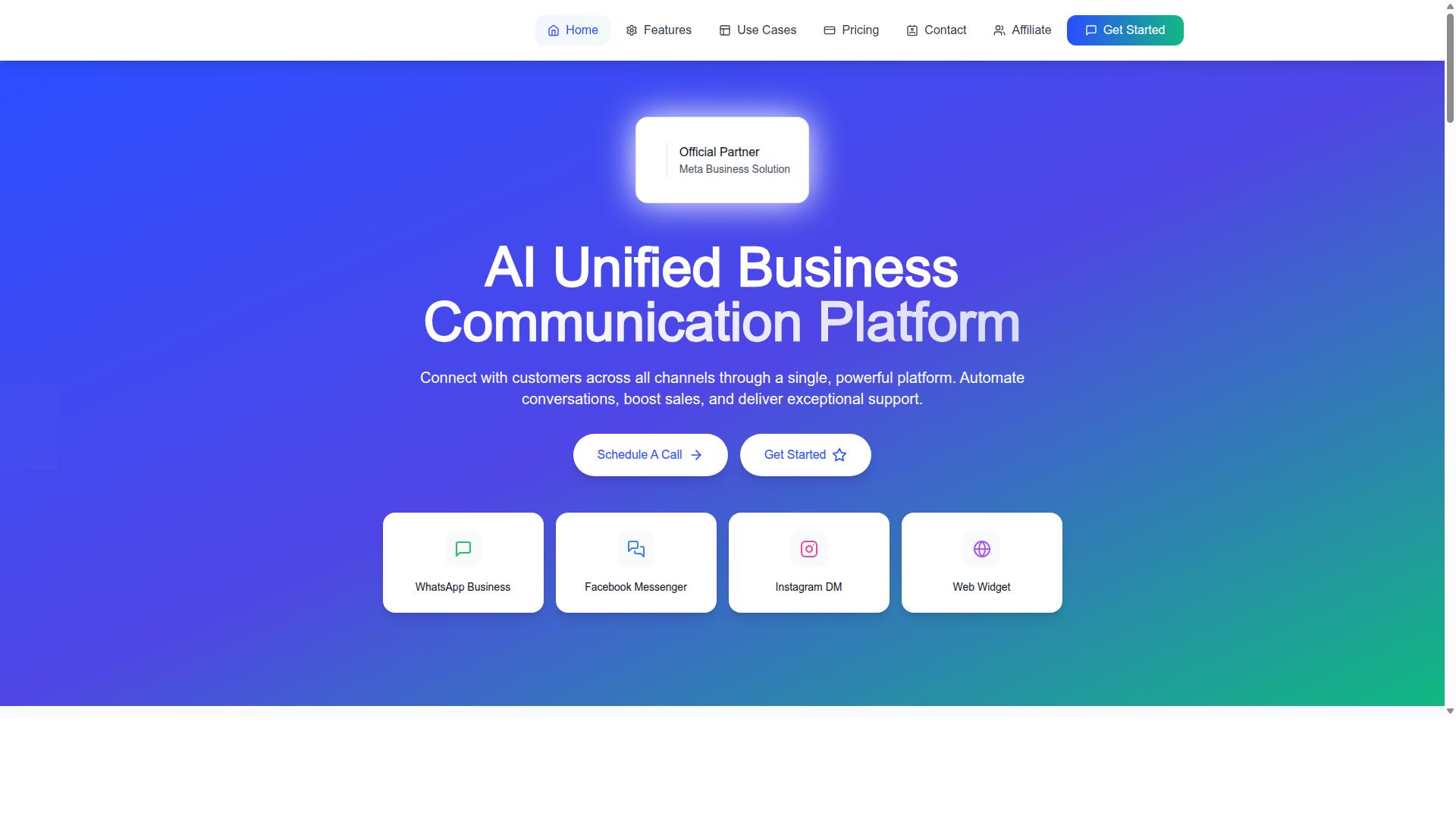
Com.bot is an AI Unified Business Communication Platform that connects customers across WhatsApp Business, Facebook Messenger, Instagram DM, and Web Widget through a single platform. Instead of juggling separate tools for each channel, teams work from one shared space where every conversation lives.
That unification matters for anyone comparing direct message tools in 2026. Instagram DM automation rarely happens in isolation. A prospect might comment on a post, reply to a story, then follow up on WhatsApp. Com.bot keeps that journey in one thread rather than scattering it across disconnected inboxes.
The platform is built around AI-powered responses and conversation automation. It supports automation of conversations, sales boosting, and support delivery, so the same system can greet new leads, answer common questions, and move warm prospects toward a purchase.
Com.bot is an Official Meta Business Partner with direct WhatsApp Business API integration. That status reflects a verified relationship with Meta, which matters when Meta platform policy shapes what any Instagram chatbot is allowed to do.
Owned and managed by Com Bot AI Limited, the platform targets businesses that want to automate and scale communication without adding headcount for every new channel. For a 2026 comparison against LinkDM, this is the core distinction: Com.bot is a multi-channel communication hub, while LinkDM is generally described as an Instagram-focused DM outreach tool.
For teams weighing Instagram growth tools, the practical takeaway is scope. A single-channel tool can handle Instagram well. A unified platform handles Instagram as one part of a broader customer conversation, which tends to matter more as a business grows.
What Is LinkDM?
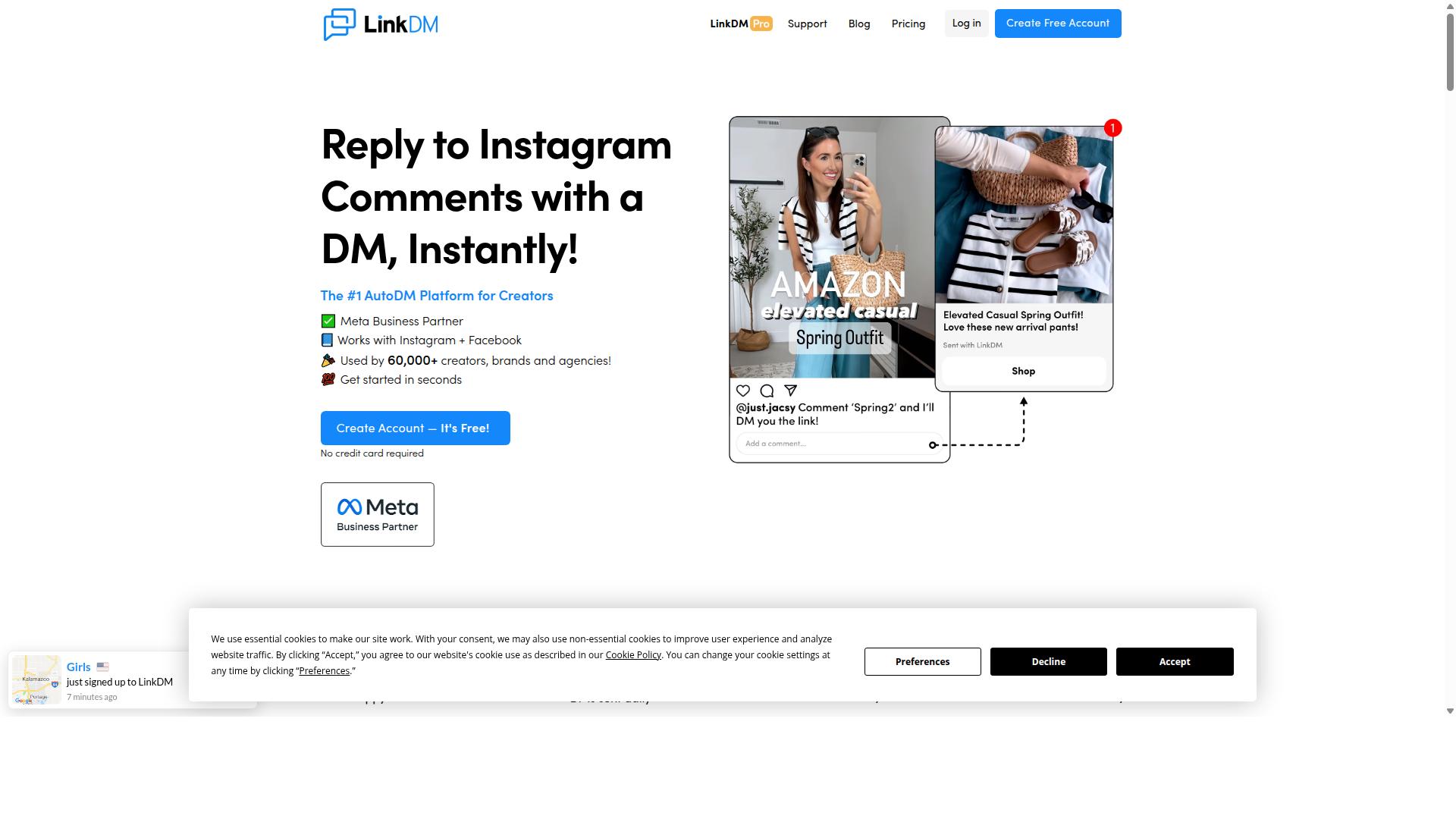
LinkDM is an Instagram DM automation tool designed to help businesses manage and automate direct messages on Instagram. It belongs to a growing category of DM outreach software built on top of the Instagram API, letting brands respond to messages without a person typing every reply by hand.
Its core purpose is straightforward: turn incoming conversations into engagement and leads. Instead of letting comments and story replies pile up unanswered, a tool like LinkDM can react automatically and keep the conversation moving.
Features in this category generally include:
- Comment-to-DM automation, where a comment on a post triggers a private message
- Story reply automation that responds when someone replies to a story
- Keyword triggers that route specific words to specific replies
- Basic conversation flow building for multi-step replies
These capabilities matter because they support lead generation at the top of the sales funnel. A keyword like "price" or "link" can start a scripted exchange that collects an email or answers a common question, all without manual effort.
Exact details vary. Feature sets, limits, and pricing for tools like LinkDM can change over time, so readers should check LinkDM's official sources for the latest and most accurate information before making a decision.
It is also worth noting that any tool operating on Instagram must work within Meta platform policy. This shapes what automation is allowed, which is why most reputable tools in the space stick to official API access rather than unofficial methods.
In the context of a 2026 comparison, LinkDM represents the typical entry point into Instagram DM automation. Understanding its general shape helps frame what to look for in any alternative, including how well a tool handles conversation flow, scale, and the broader needs of a growing business.
What Is Com.bot for Instagram DM in 2026?
In 2026, Com.bot's Instagram DM capabilities are part of its broader multi-channel platform. Rather than treating Instagram as a side project, Com.bot connects DMs to the same infrastructure that powers WhatsApp and Facebook messaging.
That structure matters for businesses running conversations across several networks. A single Unified Team Inbox collects messages from WhatsApp, Facebook, and Instagram, so agents are not juggling separate tabs or apps to keep up with customers.
Because Com.bot works through the official Instagram API, automation stays within Meta platform policy. That is a meaningful distinction in 2026, when unofficial tools that scrape or mimic the app carry real risk of account restrictions. Compliance is not a bonus feature here. It is the foundation the rest of the automation sits on.
Com.bot is not a standalone Instagram tool. It is one channel inside a multi-channel solution, which means the same bot logic, team workflows, and reporting can extend to other messaging platforms as a business grows.
Core Instagram DM capabilities include:
- Visual Bot Builder with a drag-and-drop interface for mapping conversation flow
- Smart chatbots that handle routine questions and route complex ones to people
- AI-powered responses for natural, context-aware replies
- Comment-to-DM automation that turns public comments into private conversations
- Automation Builder with 1000+ integrations for connecting DMs to outside tools
- Team Collaboration with role-based access so the right people see the right threads
The drag-and-drop builder is where most teams start. Instead of writing code, a marketer sketches the branches of a conversation. The Automation Builder then links those flows to the wider stack, covering lead generation, sales funnel steps, and handoffs into other systems.
Comment-to-DM deserves its own note. On Instagram, plenty of buying intent shows up in public comments rather than private messages. Turning those comments into DMs moves the conversation somewhere it can actually be qualified and tracked. The same logic applies to story replies, where a quick reaction can become a real sales conversation with the right automation behind it.
For teams comparing direct message tools in 2026, the practical question is whether Instagram automation lives on its own island or plugs into everything else. Com.bot takes the second approach, which tends to matter more as channels multiply.
Features Compared
This section compares the core features of Com.bot and LinkDM, focusing on automation, inbox management, integrations, security, and scalability. Both tools serve businesses that rely on Instagram DM automation, but they take different approaches to the problem.
The comparison below is based on publicly available information such as official product pages, documentation, and general market positioning. Features change frequently, especially in the fast-moving social media automation space, so details may evolve after publication.
Com.bot is an official Meta Business Partner with 23,000+ active customers, which gives it a strong foundation in Instagram and broader Meta platform workflows. LinkDM is generally presented as a leaner, Instagram-focused tool, and its public documentation is less detailed on some points.
Each subsection that follows examines one feature category in depth. Specifics are left to those sections so you can see how each capability maps to real business needs, from a simple chatbot for Instagram to a full multi-channel support operation.
Instagram DM Automation and Visual Bot Builder
Com.bot offers a visual bot builder with a drag-and-drop interface for creating Instagram DM automation flows, while LinkDM focuses on simpler automation triggers. That difference shapes what each tool can realistically do for a growing account.
With Com.bot, the visual bot builder lets teams map out conversation flows without writing code. Common building blocks include keyword triggers, story reply automation, and AI-powered responses. These pieces connect into branching paths, so a single DM can route a user toward a product question, a support request, or a lead capture step.
LinkDM, by contrast, is typically associated with more direct automation patterns. Comment-to-DM is the most commonly cited example, where a comment on a post triggers a DM. Keyword triggers are also part of the typical feature set. Exact behavior, limits, and advanced logic are less clearly documented publicly, so it is worth checking LinkDM's official sources for current specifics.
For teams running drip campaigns, lead generation, or multi-step sales funnels inside Instagram, a visual builder tends to be the more flexible option. For a creator or small brand that mainly wants comment-to-DM replies, a simpler tool may be enough.
Actionable takeaway: if your automation needs branching logic, AI-powered responses, or story reply automation, prioritize a builder that supports visual flows. If you only need one or two trigger types, a lighter tool can work, but expect to outgrow it as your conversation flow requirements expand.
Unified Inbox and Multi-Channel Support
Com.bot provides a unified team inbox that consolidates messages from WhatsApp, Facebook Messenger, Instagram DM, and Web Widget, whereas LinkDM is primarily focused on Instagram DMs. That scope difference matters most for businesses that handle customer conversations across more than one platform.
A unified team inbox means agents work from a single queue instead of switching between apps. Com.bot pairs this with team collaboration and role-based access, so different team members can be given different permissions. For support teams, sales teams, and managers sharing one account, that structure reduces the risk of missed or duplicated replies.
LinkDM's strength is its Instagram-centric focus. It generally supports Instagram DM workflows and may offer multi-account management for users running several profiles. Specifics around multi-account limits and team roles are not widely documented, so verify against LinkDM's current materials.
If your business only lives on Instagram, an Instagram-first tool can be sufficient. But once you add WhatsApp, Facebook, or a website widget, a multi-channel inbox becomes the more practical choice. Mixing separate tools for each channel usually means fragmented reporting and slower response times.
Actionable takeaway: map your current and near-future channels before choosing. A team inbox with role-based access pays off quickly for any business with more than one person handling DMs. A single-channel tool is fine only if Instagram is genuinely your entire conversation surface.
Integrations, Security, and Scalability
Com.bot offers extensive integrations along with enterprise-grade security and scalability, while LinkDM's integration and security details are less publicly documented. For growing businesses, those two areas often decide whether a tool lasts past its first year.
Com.bot's Automation Builder connects with 1000+ integrations, and the platform supports external integration. That means DM conversations can feed into the systems your team already uses, rather than sitting in a separate silo.
On security, Com.bot provides enterprise security with end-to-end encryption. On scale, the platform processes 25M+ messages per day and has created 100K+ bots, which indicates it is built for high-volume environments. It also holds official Meta Business Partner status.
For LinkDM, typical integrations are sometimes referenced, but public documentation is thinner. If integration depth or security certification is a deciding factor, review LinkDM's official sources directly.
Scalability considerations for growing businesses usually come down to three things:
- Whether the tool can handle rising message volume without degraded delivery
- Whether conversations can flow into your CRM and analytics stack
- Whether access controls and encryption meet your internal requirements
Actionable takeaway: if you expect DM volume to grow, or you need your Instagram DM automation tied into a CRM and webhook-driven workflow, prioritize a platform with proven scale and documented security. A lighter tool can serve early-stage needs, but plan for the migration cost if you outgrow it.
Pricing Compared
Com.bot's pricing starts at $149 per quarter for the Silver Plan, while LinkDM's pricing is not publicly disclosed and may vary based on usage. That single difference shapes how buyers should approach a 2026 comparison between the two Instagram DM automation platforms.
One vendor publishes its rates. The other asks you to request a quote. For teams budgeting a chatbot for Instagram, that transparency gap matters as much as the feature list itself.
Com.bot's Published Pricing Tiers
Com.bot lists three plans, all billed quarterly in USD. The site also offers an INR toggle, so international buyers should verify the currency shown at checkout before purchasing.
| Plan | Price | Positioning |
|---|---|---|
| Silver | $149 per quarter | Entry point for smaller teams |
| Gold | $349 per quarter | Recommended tier |
| Platinum V1 | $2500 per quarter | Highest tier |
The Gold Plan is the recommended option at $349 per quarter, which suggests it covers the needs of most growing accounts running DM outreach software and comment-to-DM campaigns.
Platinum V1 sits at $2500 per quarter for operations that need the top tier. Silver keeps the entry cost low for teams testing Instagram growth tool workflows for the first time.
Add-Ons and Support Costs
Com.bot separates core plans from usage-based add-ons, each priced at $10 per month. These cover an additional team member, an extra social channel, external actions per 5000, bot triggers per 25000, and an ecom store.
That structure lets a team scale multi-account management or keyword triggers without jumping to a higher plan. It also keeps costs predictable as a social media automation setup grows.
Dedicated support is billed hourly when needed: $49 per hour for WABA, CRM, and Inbox help, and $99 per hour for Ecommerce, Bots, and Automations. WhatsApp messaging runs at actual Meta rates with no markup, an unusual detail worth noting for anyone comparing total cost of ownership.
LinkDM Pricing: What Buyers Should Expect
LinkDM does not publish its pricing. Readers interested in the platform should contact LinkDM directly for a quote rather than relying on secondhand figures.
Quote-based pricing is common in this category, and it is not automatically a drawback. It can suit enterprises with unusual volumes or custom requirements.
The trade-off is evaluation speed. Without a public rate card, a buyer cannot easily model costs against Com.bot's published tiers or forecast spend across a sales funnel before committing to a demo call.
Value Comparison by Tier
Com.bot's tiers map cleanly onto team size and usage. Silver suits a lean operation, Gold fits most accounts running AI-powered responses and lead generation at scale, and Platinum V1 serves high-volume needs.
Add-ons let you extend team inbox seats, role-based access, or additional channels for $10 per month each, so the plan you pick does not lock your growth path.
Because LinkDM's costs are undisclosed, a direct value comparison is not possible from public information alone. Buyers evaluating DM outreach software should request a LinkDM quote, then weigh it against Com.bot's published $149, $349, and $2500 quarterly tiers, plus the $10 monthly add-ons and hourly support rates.
For teams that value transparent, forecastable pricing in a 2026 comparison, Com.bot's public structure makes budgeting simpler from day one.
Who Should Choose Com.bot
Com.bot is ideal for businesses and organizations that need to manage customer communication across multiple channels, including WhatsApp, Facebook, and Instagram, from a single platform. That multi-channel foundation sets it apart from tools built around a single network. For teams that already handle customer conversations in more than one place, consolidating them in one dashboard removes a layer of friction that single-channel tools cannot address.
The platform is used by 23,000+ active customers and 100+ government bodies, which speaks to both its reach and its ability to meet stricter operational standards. Those figures matter for buyers who want a vendor with a track record across very different types of organizations, from growing businesses to public sector teams.
Com.bot tends to fit best in a few recurring situations:
- Multi-channel support teams that answer questions on WhatsApp, Facebook, and Instagram and want one place to work from
- Enterprises and government bodies that need official Meta partnership and enterprise-grade security in their communication stack
- Sales and marketing teams running bulk messaging, order updates, payment collection, and sales funnel automation
- Organizations that value automation at scale rather than handling each conversation manually
Use cases like bulk messaging, customer support, and sales funnel automation show up across these groups. A retailer might send order updates on WhatsApp while handling Instagram inquiries in the same interface. A public agency might manage citizen questions across channels without switching tools. The common thread is volume plus variety: many conversations, more than one channel, and a need for consistent handling.
If your team operates on Instagram alone and expects to stay that way, a single-channel tool may cover the basics. But once WhatsApp or Facebook enters the picture, or once security and official platform standing become procurement requirements, Com.bot's multi-channel and enterprise positioning becomes the more practical fit for 2026.
Who Should Choose LinkDM
LinkDM is best suited for businesses and creators whose primary focus is Instagram growth and engagement through direct message automation. If Instagram is your only channel and your entire strategy revolves around it, a single-platform tool can feel like a natural fit.
These users typically want a focused tool rather than a multi-channel chatbot for Instagram and beyond. They value simplicity and are comfortable with the tradeoffs that come from a narrower scope.
Before committing, check LinkDM's official resources for current feature details, since capabilities in this space change frequently and vary by plan.
Influencers and content creators are a common fit. They often receive high volumes of story replies and comments, and automation helps them respond without losing the personal tone their audience expects.
Small businesses with an Instagram-first presence also qualify. A local shop or service provider that runs its entire funnel through Instagram may find a dedicated tool sufficient.
Marketers running Instagram-only campaigns round out the group. When social media automation is scoped to one platform, a specialized product can be easier to learn and manage.
- Comment-to-DM workflows: Auto-sending a DM when someone comments a keyword on a post.
- Story reply automation: Responding to story reactions and replies with preset or guided messages.
- Lead generation on Instagram: Capturing interest in DMs and routing it toward a next step.
- Keyword triggers: Firing specific replies when users send certain words in a DM.
These use cases are well-established in Instagram DM automation and are the core reason single-platform tools exist. If your workflow maps neatly onto this list, LinkDM is worth evaluating.
One caveat: features, limits, and pricing in this category shift often, and platform rules under Meta platform policy evolve too. Confirm current capabilities directly with LinkDM before you build a process around them.
If your needs later expand beyond Instagram, or you want broader conversation handling across channels, a multi-channel approach may serve you better. For an Instagram-only operation, though, a focused tool can be the simpler starting point.
Who Should Choose Com.bot for Instagram DM in 2026
For Instagram DM automation in 2026, Com.bot is the better choice for businesses that need a scalable, multi-channel solution with advanced AI and compliance with Meta policies. That combination matters more than ever, because the rules governing Instagram automation have tightened while customer expectations for fast, personalized replies have risen.
The strongest signal of trustworthiness is Com.bot's status as an Official Meta Business Partner. For teams that cannot afford account restrictions or disruptions, working through a partner aligned with Meta platform policy is a practical risk-reduction decision, not just a badge.
Com.bot also operates well beyond Instagram alone. The platform handles 25M+ messages per day across its customer base, which speaks to the kind of volume a multi-channel setup can absorb without buckling during peak campaigns.
Consider which buyer profiles get the most value:
- Growing brands with multiple channels: teams that want one system for Instagram and other messaging surfaces rather than juggling separate direct message tools.
- Agencies and partners: with 500+ global partners and 100K+ bots created, Com.bot suits organizations building repeatable automation for many clients.
- Public sector and enterprise teams: 100+ government bodies rely on Com.bot, pointing to the security posture serious institutions require.
- Scaling SMBs: part of a base of 23,000+ active customers that need quick setup without a lengthy build.
Feature depth separates the two tools for advanced users. Com.bot offers a visual bot builder and AI-powered responses, which support conversation flow design. Teams running keyword triggers, comment-to-DM, or story reply automation can shape those journeys without writing code.
Compliance and scalability are the two forces shaping 2026. Meta platform policy continues to reward tools that respect rate limits and messaging consent, and enterprise security with end-to-end encryption gives regulated teams confidence. Real-time message delivery keeps engagement automation responsive, while quick setup and integration shortens the path from decision to launch.
LinkDM may remain a reasonable fit for narrow, single-purpose outreach, and simpler tools can be easier to learn. But businesses weighing a 2026 comparison should ask whether a platform can grow with them, stay compliant, and connect across channels. On those criteria, Com.bot is the stronger long-term choice.
Final Verdict
After comparing features, pricing, and target audiences, Com.bot stands out as the more comprehensive solution for businesses seeking a unified, multi-channel communication platform.
LinkDM remains a reasonable pick for a narrow use case. If your entire strategy lives inside Instagram and you only need basic Instagram DM automation, a focused tool can cover that ground without extra complexity.
The gap appears when your needs grow. Multi-channel support, official Meta partner status, and enterprise-grade security are not nice-to-haves for scaling teams. They are the foundation that keeps DM outreach software reliable as volume climbs.
| Consideration | Com.bot | LinkDM |
|---|---|---|
| Channel coverage | Multi-channel | Instagram-focused |
| Platform standing | Official Meta partner | Not specified |
| Security | Enterprise-grade | Not specified |
| Best fit | Scaling, multi-channel teams | Simple Instagram-only automation |
Choose Com.bot if you run campaigns across more than one channel, need room to scale, or answer to security and compliance requirements. Choose LinkDM if Instagram is your only surface and your workflows stay simple.
For teams weighing this decision, a direct conversation beats guessing. Com.bot's team can be reached at [email protected] or +91 080 6987 1810, Monday to Friday, 9:00 AM to 6:00 PM IST. WhatsApp support is also available.
Frequently Asked Questions
What is the main difference between LinkDM and Com.bot for Instagram DM?
LinkDM is primarily a dedicated Instagram DM automation tool, while Com.bot is an AI Unified Business Communication Platform that connects Instagram DM alongside WhatsApp Business, Facebook Messenger and Web Widget in one place. So if you only need Instagram, LinkDM may fit; if you want Instagram as part of a broader multi-channel strategy, Com.bot is built for that. Com.bot is an Official Meta Business Partner and currently serves 23,000+ active customers across 50+ countries.
How does pricing compare between LinkDM and Com.bot?
LinkDM publicly lists a free plan (up to 1,000 DMs/month, 1 Instagram account), a Pro plan at $19/month for up to 3 accounts and 25,000 DMs/month, and a Platinum plan at $99/month for up to 10 accounts and 300,000+ DMs/month. Com.bot's plans are structured differently: Silver at $149 per quarter, Gold at $349 per quarter (recommended), and Platinum V1 at $2500 per quarter, with add-ons such as $10 per month for an additional team member, social channel, or external actions and bot triggers. Because the two tools bundle different capabilities, it's worth comparing what's included in each plan rather than headline price alone.
Can Com.bot handle Instagram DM automation the way LinkDM does?
Yes. Com.bot supports Instagram DM as one of its core channels, alongside WhatsApp, Facebook Messenger and Web Widget, all managed from a single platform. It includes a Visual Bot Builder with a drag-and-drop interface and an Automation Builder, so you can automate conversations and replies without coding. The key difference is that Com.bot is designed to run Instagram automation as part of a unified multi-channel setup rather than as a standalone Instagram tool.
Which tool is better for a business that also uses WhatsApp and Facebook?
If WhatsApp and Facebook Messenger are part of your customer communication, Com.bot is purpose-built for this: it unifies WhatsApp Business, Facebook Messenger, Instagram DM and Web Widget in one platform with a Unified Team Inbox. It also offers WhatsApp Business API integration and native payments for WhatsApp transactions. LinkDM, by contrast, is focused on Instagram DM automation, so a multi-channel operation would typically need additional tools alongside it.
Is Com.bot suitable for small businesses, or is it only for large enterprises?
Com.bot serves a broad range of customers - from growing businesses to government bodies and enterprises - with 100+ government bodies, 500+ global partners and 100K+ bots created to date. Entry-level plans like Silver ($149/quarter) make it accessible to smaller teams, while higher tiers and add-ons scale with larger operations. Its quick setup and integration also means smaller businesses can get started without a lengthy onboarding process.
How do I decide between LinkDM and Com.bot in 2026?
Start with scope: if Instagram DM automation is your only requirement and you want a free entry point, LinkDM's published plans may appeal. If you need Instagram DM as part of a unified platform covering WhatsApp, Facebook Messenger and Web Widget - with a Unified Team Inbox, Visual Bot Builder, automation, and enterprise-grade end-to-end encryption - Com.bot is the stronger fit. You can review Com.bot's plans and reach the team via [email protected] or WhatsApp support (Monday-Friday, 9:00 AM-6:00 PM IST) to match a plan to your needs.